
famoe.ly - I wanted a practice set list, what I got was much more
👉🏻 famoe.ly
I just wanted to create a playlist I can listen to that will most likely have a solid selection of songs I'm going to hear August 13/14/15. I ended up with a prob and stats model that has produced close to 90% accurate predictions (citation needed, see "Context" below).
⦾ famoe.ly - Nerd Math and Jam Bands
Back in February this year (2026) my Uncle Tim and I caught the first 2 nights of the opening run of moe's "Born to Fly" tour, at Higher Ground in Burlington, VT.
It was great. My only note: I wish we had realized sooner that it was 3 nights, not 2.
Going into that (unforgettable) experience I felt pretty confident in my knowledge of moe's catalog. They've been around for about 35 years and primarily tour, so that's a lot of potential music to keep up with. I was mistaken. There were a lot of songs they played those two frigid Burlington nights that I wasn't familiar with. And that's cool, ya know? You're allowed to play music I'm not familiar with.
At the time I didn't feel like I got everything I wanted out of it.
Because of the hard work of the tapers like Phil Hernandez I've been able to listen to those two nights on repeat (and the third night we missed) and it's even better than what I remembered. Which was, to be completely honest, already pretty fucking great.
⦾ Get to the Point
OK let me stop burying the lede. This update is about the weeks of work I've put into some data analytics/modeling/probability software. Basically "setlist.fm but better". I'm going to do my first "follow the band" trip in August and I wanted to be sure I was familiar with enough of their recent touring catalog to not get taken by surprise again. It's just how I enjoy music. Don't knock it. So I made a few things.
My objective was to create some kind of script that will generate a pool of a few dozen songs that are most likely to play on the 3 night run I'm catching them in August. All I wanted was to create an actual playlist (on the computer) that I can listen to that probably covers most of what I might hear (songs I wasn't prepared for).
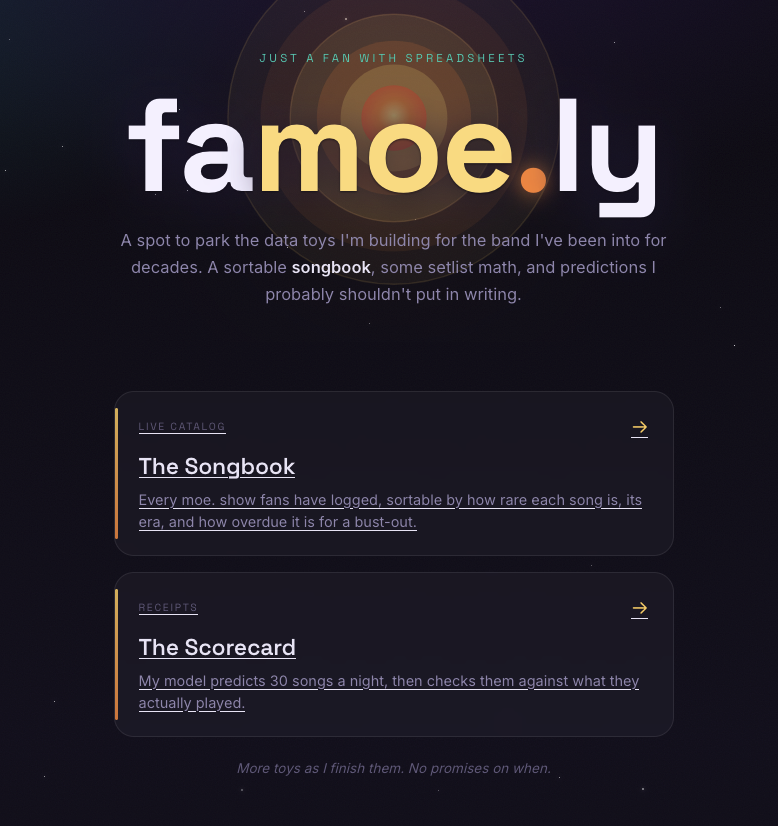
It turns out once you build that foundational model and data pipeline you can build a lot of other prob and stats stuff with very little extra effort. And when you add an LLM assistant, you can accelerate that like whoa.
⦾ The Scorecard
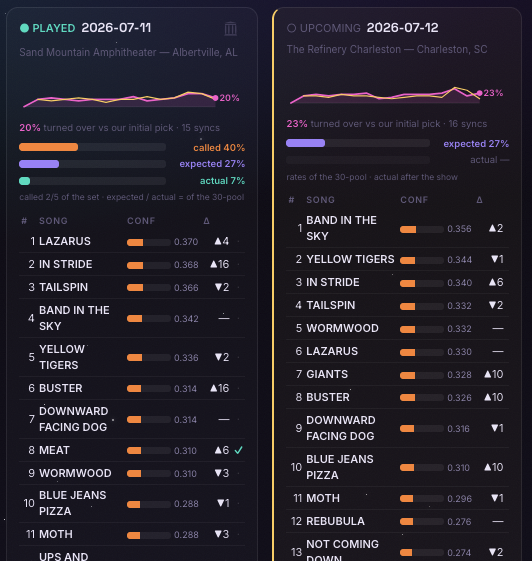
The Scorecard is a prettier and more useful version of the first iterations of what the model was producing. This version keeps history and shows you how the predictions change over time as more results come in and the model is able to improve its predictions.
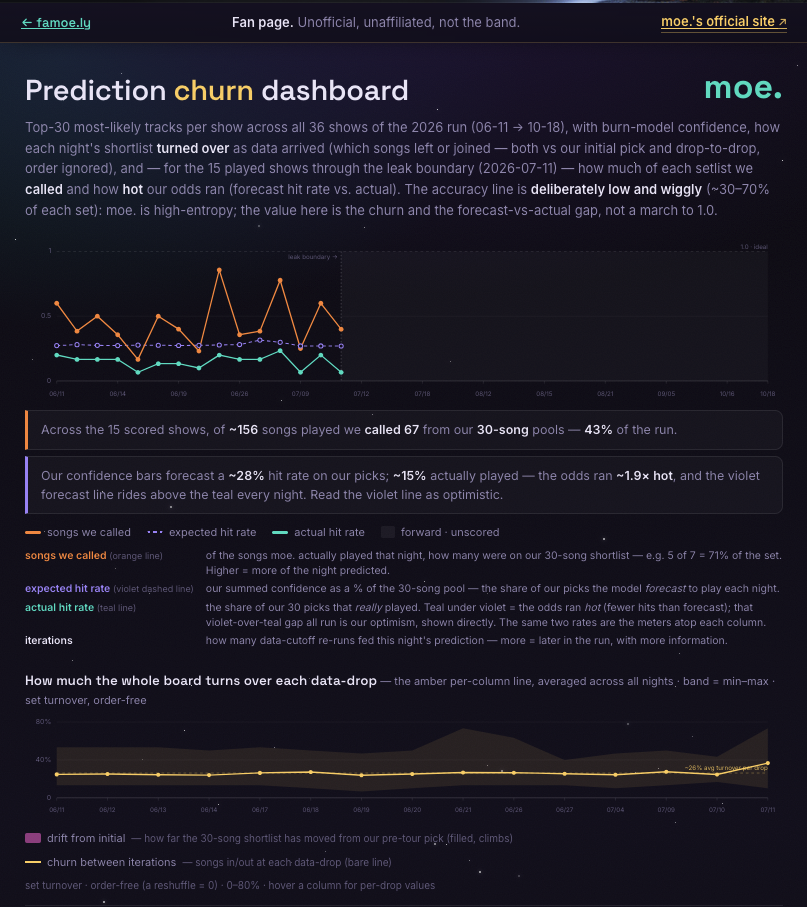
Here are examples of two nights side by side. You can already see that there's a lot of data in this. It's a lot more interesting if you load the page and explore it yourself.
The model ingests data from 3 sources.
- Archive.org API
- Setlist.fm API
- Machine vision parsing Instagram posts
Data ingestion is weighted in that order. We prefer to build nightly data based on taper uploads in the moe. collection on archive.org. We supplement that with data from setlist.fm when archive is lacking. And if all else fails we fall back to me personally feeding a Python parser data from their Instagram page.
Speaking of data. Did you notice that pretty little building icon? Let me show you a closer screenshot:
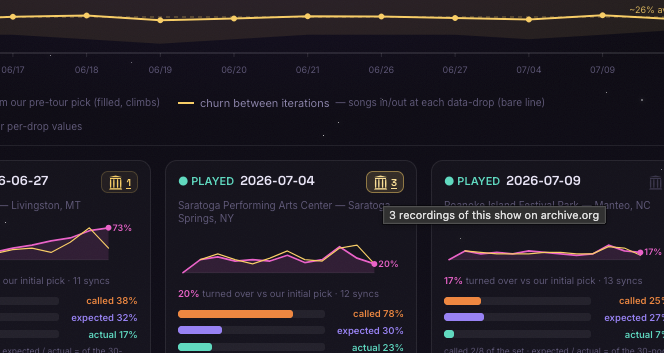
As we parse new data we update the database. That means that when the predictions are updated we're able to automatically update all churn tables to give you links to recordings we found on archive.org when we were building the data set. Obviously this information is not available for dates that haven't passed yet :-)
The churn dashboard starts at the beginning of June because… I had to start somewhere. And at the time I was having to manually do a lot of data wrangling. Eventually my automation was upgraded enough to backport to 2020. It seemed like a fine place to stop. There's no reason I couldn't extend it back further. I just don't need data that old for what the model is doing.
Speaking of which, what exactly is the model doing?
⦾ What It Does
The model runs hundreds of thousands of simulations, using time based weights, decays, and other "dampening" methods to predict future set lists. It's just not reasonable to predict a 10 track set any given night. They have scores of songs. Literally hundreds if you're being particular.
That's where The Songbook comes in.
If you filter The Songbook to just 2026, and only
include Anchors, Core Rotation, Regular Rotation, and Deep Cuts you
still end up with 100 songs:
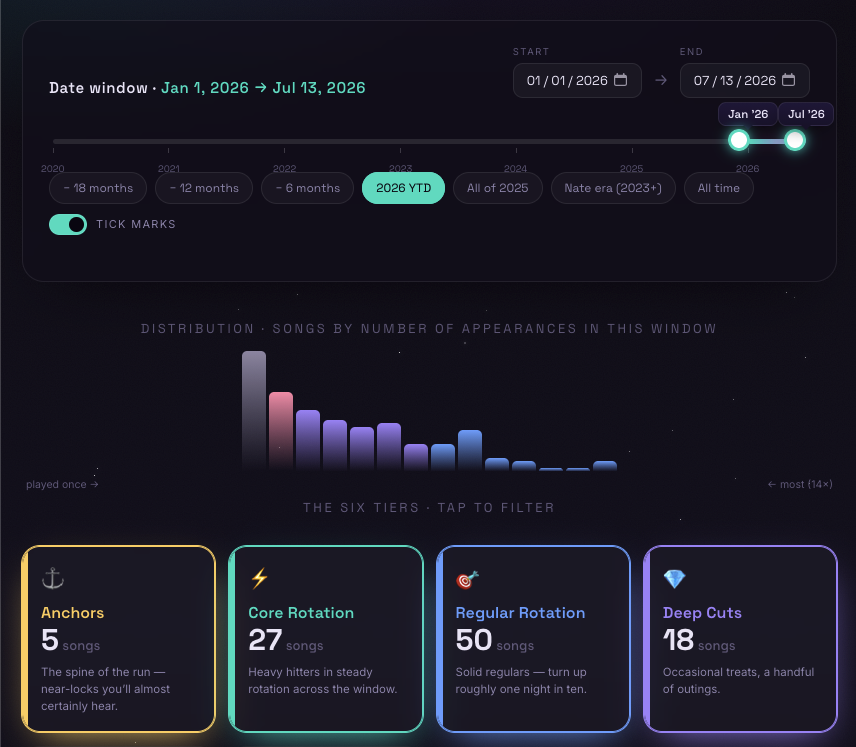
What we can do is use probability and statistics to create a model for how they historically write up set lists, and refine our predictions based on that. We can incorporate a lot of attribute into this, such as venue type, if we're in "a run" (several nights back to back), and even things like estimated set list length and historical data. I'm not including all of that in the model yet, it's a work in progress. Some things like learning average song/jam length are coming in the next iteration. That greatly influences what we could expect to hear in a given night. You wouldn't put 4 songs that tend to descend into 30+ minute jams into the same prediction for a given night in a small coffee-house venue. You can also start to look for common segues and absolute exclusions.
Just look at the performance
history and
notable
performances
of The Dead's famous jam Darkstar on Wikipedia.
Anyway.
⦾ Context
In the intro I said
citation needed, see "Context" below
Here's the context. That "90%" accuracy quote was not a lie, but also not the whole truth. You read this far, strap in for some basic math.
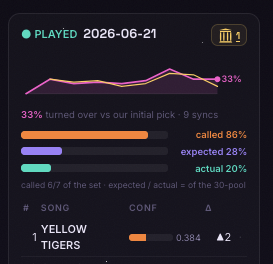
Earlier I also said that we don't make 10 song predictions when we're building
predictions. We'd never get anything close to useful from that. We actually
build 30 song pools when we make predictions. Each of those has a probability
normalized from 0->1. On average given a recall@30 we "predict" 8 songs. The
model reports its nightly "expected" rate at about 20-25%, and most of the time
it's spot on. That cherry-picked screenshot above says we called 86% of the
show. But we picked 30 songs. There were only 7 songs played that night
Side note, that little greek building icon with the
1next to it means there is 1 recoding on archive.org for that show, you could listen to it right now
When the model says 25% expected, it means it thinks about a quarter of the songs in the prediction list, the 30-song pool, will show up in the actual playlist. A lot of the time that turns out to be right. 20-30% of 30 is in the 6-9 song range.
But we didn't produce an artifact that had the exact number of songs in the show that night.
⦾ recall@100
I said recall@30 earlier, that's a tuning parameter of the model. If we make
the number there larger and larger our "hit rate" will increase and approach 1.0
(100%). That's because we would be producing a 100-song prediction pool.
Do you recall what I said earlier about the song book? If you filter to just the most likely stuff this year, there they have already played 100 songs. It's a coincidence that recall@100 would get us close to "100%" correct. But it's a handy way to explain what this model does and DOES NOT do.
The model DOES NOT produce 90% accurate 10-song set lists
The model DOES produce pools of 30 most likely songs, of which about 25% tend to show up. And sometimes, of those 6-9 songs that might play (it's never the top 6-9% by probability), more than half are actually played.
I'm pretty happy with that.
⦾ The Setlist
What is the current "practice list"?
- Band in the Sky
- In Stride
- Yellow Tigers
- Buster
- Letter Home
- Tailspin
- Wormwood
- Lazarus
- Rebubula
- Giants
- Happy Hour Hero
- Bat Country
- Meat
- Downward Facing Dog
- Head
- Big World
- Silver Sun
- Mexico
- Captain America
- Billy Goat
- Blue Jeans Pizza
- Plane Crash
- Moth
- Ups and Downs
- Shoot First
- Haze
- Seat of My Pants
- Bring You Down
- Okayalright
- Puebla
- The Pit
- Not Coming Down
- Wind It Up
- Kyle's Song
- Timmy Tucker
- Water
- Recreational Chemistry
- Tomorrow Is Another Day
- Bullet
- New Hope for the New Year
- All Roads Lead to Home
- George
- Gone
Most nights they play the prediction churn model only shuffles about probability. Every now and then a few songs enter or exit.
But right now, this is the most likely set of songs I'll hear on August 13/14/15 (and maybe you too!)
To be clear, the model generates this list doing a union across the 3 most likely 30-song pools across those 3 nights.